Publikation
Datum:
October brought no new central bank hikes (the Fed on 28 Oct, ECB on 29 Oct and BOJ on 30 Oct all held, with a hawkish tilt), but long yields peaked on 7 October and then fell as an AI-driven equity sell-off pushed markets into risk-off mode, while the AI funding story (see page 3) and French debt stress dominated the second half of the month.
EUROZONE
Deposit Rate: 2.50%
held 29 Oct; Dec hike probability ~67%
HICP: 3.8% y/y (Sept)
core 2.5%; German Oct flash 2.8%
ECB held, but flagged December as live.
On 29 October the Governing Council kept the deposit rate at 2.50% after debating a hike; Christine Lagarde said the direction of travel is quite clear, while no second-round effects are visible yet. She will step down on 7 February 2027.
France was the flashpoint.
The 10-year OAT reached 5.14% on 22 October and the spread to Bunds about 178bp, the widest since 2011; Moody's then held Aa3 (negative outlook) on 23 October and the spread eased to ~157bp. Fitch held A+ but changed outlook to negative on 30 October.
Inflation:
HICP was 3.8% in September; the October flash is due on 4 November.
UNITED STATES
Fed Funds: 3.75–4.00%
held 28 Oct, 10–2; Dec hike probability ~77%
US CPI: 3.7% y/y (Sept)
core 2.6%; gasoline-led
Fed held, with two dissents for a hike.
On 28 October the FOMC kept the range at 3.75–4.00% in a 10–2 vote, with Governor Cook (her first dissent) and Cleveland's Hammack preferring a hike. The minutes showed broad support for the September hike and that most officials expect another by year-end. Warsh called growth strong and inflation too high but gave little guidance on December, now priced near 77%; Logan said at least two more hikes are needed and Musalem wants one soon.
Inflation and data keep the hawks in control.
September CPI rose 3.7% y/y (+0.6% m/m, gasoline-led) against 3.6% expected, with core at 2.6%, while the third-quarter employment cost index slowed to +0.8% q/q. September payrolls were a weak +29k (unemployment 4.2%); the October jobs report on 6 November is the next test. Brent near $113 keeps energy the main inflation driver, and Fed officials note that AI capex adds to demand and supply strain.
Bond market: The US 10-year yield touched 5.36% on 7 October (a 24-year high; 30-year 5.70%) before a strong $39bn auction (bid-to-cover 2.77) and a flight to safety pulled it to 4.94% by 30 October, a 35bp fall and the largest monthly decline since December 2023; the 30-year ended at 5.31%. Japan's 10-year held near 3% and Germany's eased from 3.65% to about 3.4%. Brent rose about 14% to roughly $113 on Hormuz and Houthi supply risks, while gold fell about 7% to its lowest close in a year, near $3,900.
Equities, AI-led sell-off: the S&P 500 closed October at 7,580 (about -1%) and the Nasdaq Composite fell 5.3%, its worst month since March 2025, including a 2.9% drop on 30 October after Amazon, Alphabet and Intel results raised doubts over AI spending and free cash flow; the Dow still gained about 1.5% as money rotated to defensives, and the VIX rose to about 19. Q3 bank earnings were solid (JPMorgan net interest income +13%, Goldman equities trading +72%) but fixed income trading was soft. Earlier in the month analyst warned that the equities earnings cushion over bond yields were shrinking due to high yields and elevated valuations.
Crypto: weak, with Bitcoin at about $76,800 versus $83,600 at end-September as the AI sell-off and a record hack at Binance (about $6bn, with the exchange absorbing losses) hit confidence.
Will AI productivity gains cover the cost, and how the hunt for funding helps keep global yields elevated
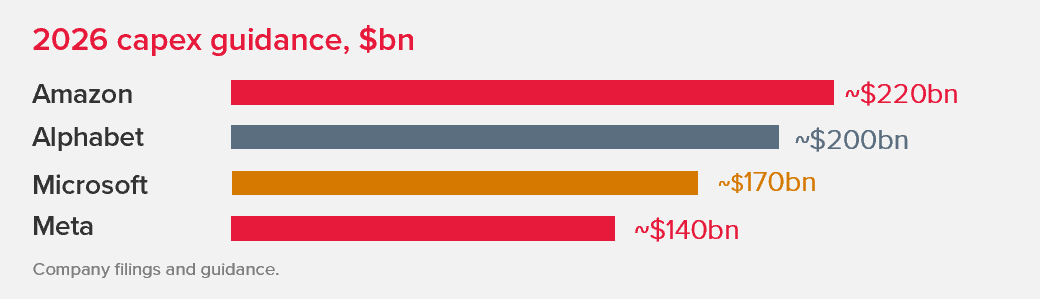
Mag-Four capex 2026: ~$730bn
vs ~$410bn in 2025; >$1tn seen for 2027
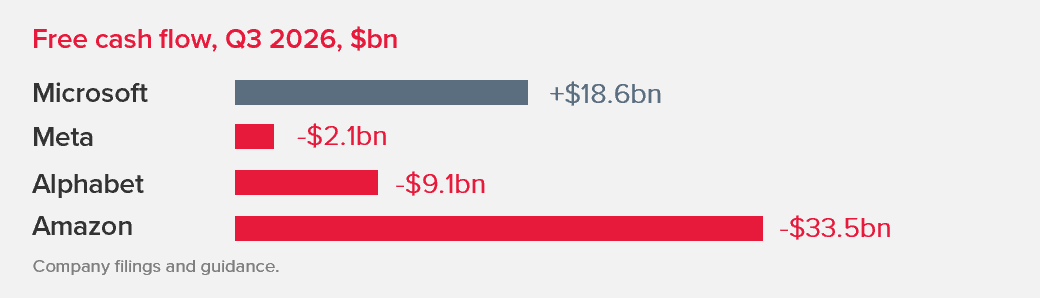
Meta FCF: -$2.1bn (Q3)
Its first negative quarter since 2012; Alphabet -$9.1bn
Anthropic H1 (S-1) loss: $80.7bn
IPO filing: $72.4bn is a non-cash note revaluation;
Op loss $0.7
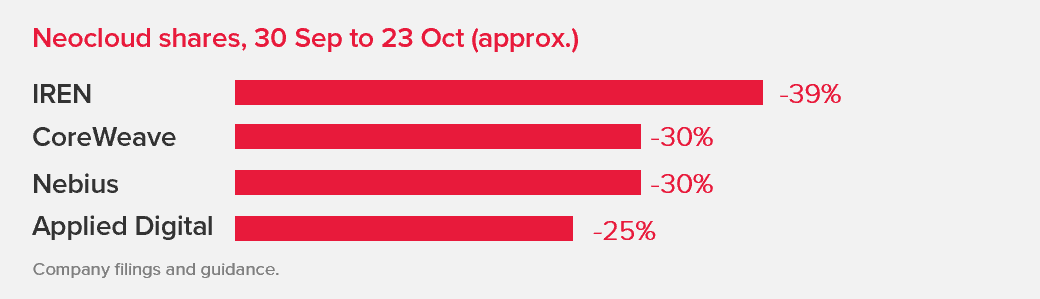
Neocloud shares: -25% to -40%
CoreWeave, Nebius bond prices at record lows
Demand is real: Azure grew 48% and Anthropic's revenue reached $16.3bn in the first half, up from $1.2bn. But cash is the constraint. In Q2, capex was 95–119% of operating cash flow at Meta, Alphabet and Amazon, free cash flow has since turned negative at all three, Meta has paused buybacks, and about two thirds of Microsoft's spend goes to short-lived chips. Productivity gains are not yet visible in aggregate; the visible effect is cost cutting, with Microsoft offering buyouts to about 60,000 staff. With capex heading toward $1tn, returns must arrive before depreciation does.
Hyperscalers issued about $220bn of bonds through August, and markets noted as their CDS spreads trade about 60bp wider than those of banks. Neoclouds lack that access: Musk said funding is almost shut for those without non-AI revenue, and CoreWeave and Nebius bonds hit record lows. Anthropic’s S-1 (its US IPO registration filing) reports an H1 net loss of $80.7bn, including a $72.4bn non-cash revaluation of convertible notes following an increase in its valuation. Its operating loss was $0.7bn. Some investors speculated an investment-grade rating may be out of reach. At the same time private equity firms are adding portfolio debt to pay out cash while IPOs stay shut.
All these borrowers compete for the same pool of capital as governments. This supports some of the arguments that the bond bear market has more to go because states and companies are competing for funding, and the US 10-year hit 5.36% on 7 October. Long-dated hyperscaler supply adds to term premia, AI demand for chips, memory and power adds to inflation (Fed officials cite it), and central banks lean toward more hikes. In October the link ran both ways: AI funding fears triggered a flight to safety that cut the 10-year by 35bp, but supply and inflation pressures remain.
The AI build-out is now a credit and funding story, not only a technology one. Banks and portfolio managers face growing exposure to data centre, GPU-backed and neocloud lending, hyperscaler paper in investment-grade indices and private-credit vehicles holding the same risk. Collateral values depend on chips that depreciate within a few years, so a funding stop at weaker neoclouds could spill into leveraged loans, ABS and bank lines, while competition for capital keeps term premia and funding costs high.
What to watch: Anthropic IPO pricing (possible in November) and any rating; Apple, Palantir and AMD earnings in early November; hyperscaler bond issuance and CDS spreads; neocloud refinancing; and January capex guidance.
AI-funding fears resurfaced with new intensity, yields peaked early in October then eased but inflation, hawkish central banks and heavy bond supply keep them elevated: what October means for treasury and risk teams. The implications, key takeaways, and market figures that frame them.
The US 10-year Treasury yield peaked at 5.36% on 7 October and then fell about 35bp on a strong auction and a flight to safety, yet inflation is re-accelerating (US CPI 3.7%, euro area 3.8%) and oil is near $113, so the inflation component is real. At the same time the case for a capital-scarcity premium grew: governments, hyperscalers, neoclouds, AI labs and private equity all need funding, some investors argue the bond bear market has still more to go, and yields fell in October mainly as a risk-off reflex, while others are convinced this is a rare, once-in -decades buying opportunity for conservative debt investors. The likely answer is both: inflation sets policy rates, while supply and credit premia set the long end. For banks, this means mark-to-market pressure on securities books and HQLA, IRRBB sensitivity at the long end, wider spreads on AI-linked credit and volatile collateral haircuts.
The Fed held on 28 October with two dissents for a hike, the ECB held while saying the direction is clear, and the BOJ held with December open; markets price December hikes at about 77% (Fed) and 67% (ECB). Warsh gives little forward guidance, so data releases now move the path: the October jobs report on 6 November and October CPI in mid-November will matter. The risk is two-sided: growth is firm and inflation high, but the AI-related equity sell-off, a weak September payroll (+29k) and French stress could tighten financial conditions on their own. Estimates show that the rise in yields since September has done the work of a 25bp hike in Germany and about 50bp in France. For banks, this higher-for-longer funding costs regime combined with an energy shock raises risk of credit stress in consumer and energy-sensitive segments. Tensions in France are not easing up and need to be monitored closely.
| Date | What to watch |
| 3 Nov: | US midterms (House seen going Democratic, Senate close); watch yields and deficit expectations. |
| 4 Nov: | Treasury quarterly refunding; euro area October flash HICP. |
| 5-6 Nov: | BoE (5 Nov); US October jobs report (6 Nov); French CGT protests (5 Nov). |
| Mid-Nov: | US October CPI. |
| November: | Anthropic IPO and rating; S&P on France (27 Nov, A+); neocloud refinancing. |
| 6 Nov and 8–9 Dec: | US October jobs report; FOMC with new projections. |
| 8-9 Dec: | FOMC with new projections (hike ~77%); BOJ also meets in December. |
| 11 and 17 Dec: | US stopgap funding expires (shutdown risk); ECB projections, hike ~67%. |
| Throughout: | Hormuz, Brent near $113, US 10-year near 5% and the OAT-Bund spread. |
| Metric | Value |
| US CPI (y/y, Sept) | 3.7% |
| Eurozone HICP (y/y, Sept) | 3.8% |
| Fed Funds target range | 3.75% – 4.00% |
| ECB Deposit Facility Rate | 2.50% |
| US 10Y Treasury yield | 4.94% |
| US 30Y Treasury yield | 5.31% |
| German 10Y Bund yield | 3.4% |
| EUR/USD | 1.1164 |
| Gold (USD/oz) | $3,874 |
| Brent crude (USD/bbl) | $113 |