Updates
Date:
The European Banking Authority (EBA) is pursuing a clear objective with its Simplification Package: supervisory reporting should become simpler, more proportionate, and more focused on genuinely relevant risks. However, the stress testing module demonstrates that simplification should not be mistaken for a reduction in technical or regulatory requirements. Rather, the focus is shifting from separate, project-based stress test data collections towards permanently available, consistent, and auditable data embedded within regular regulatory reporting.
For institutions, this is far more than a reporting issue. The proposed changes affect data architectures, governance structures, reporting processes, risk management, finance, treasury, and ESG functions alike. Institutions that view these amendments merely as technical extensions of individual reporting templates risk underestimating the true scope of the challenge. The key issue is the ability to provide regulatory data that is continuously explainable, controllable, and relevant for management decision-making.
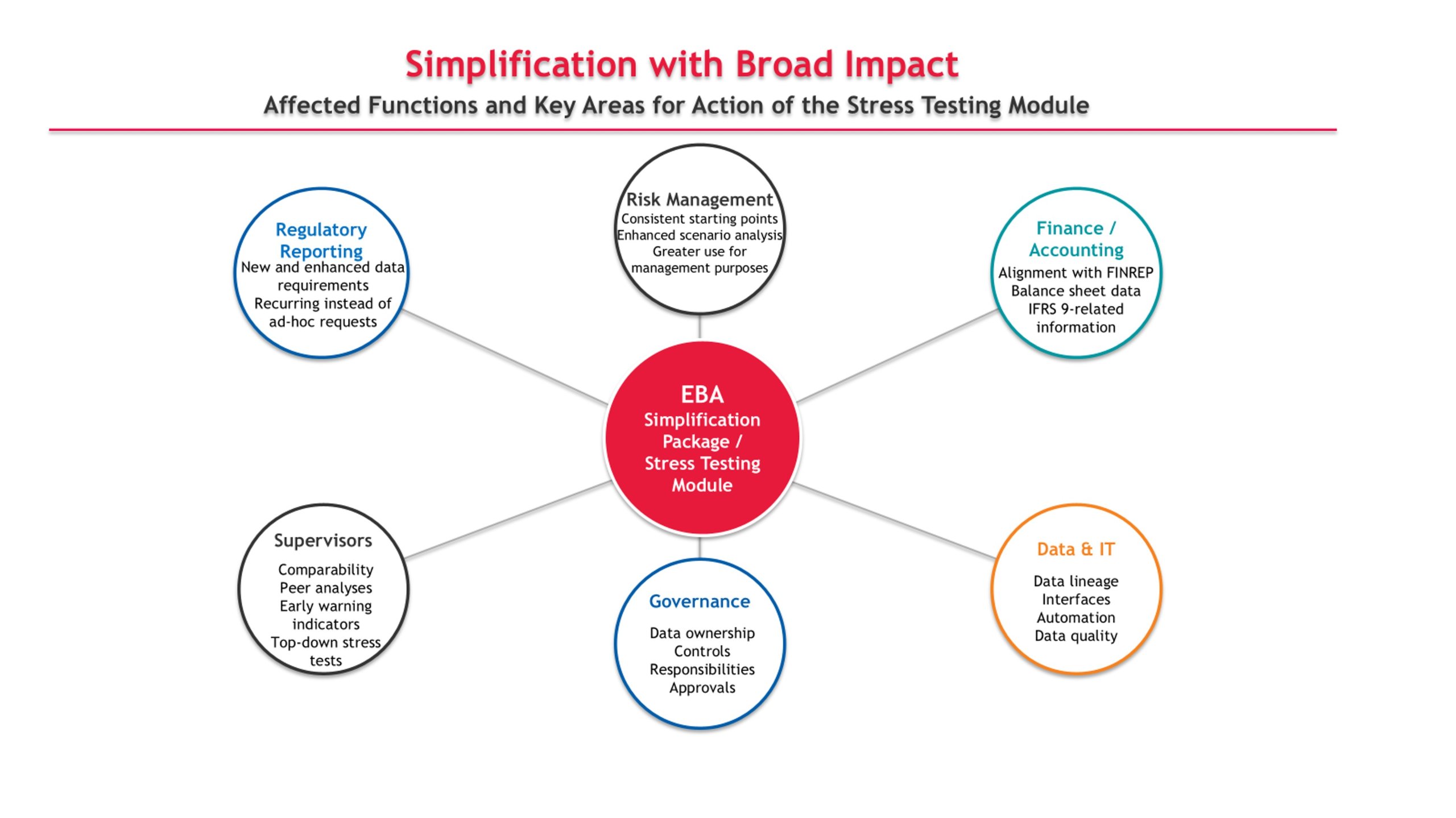
The regulatory simplification agenda therefore also represents a strategic call for banks to further integrate their data and management architectures.
A central element of the proposed changes is the integration of selected EU-wide stress testing data requirements into FINREP, COREP, and ESG reporting. Data that has traditionally been collected, manually prepared, and reconciled specifically for stress testing exercises will increasingly be sourced through existing or enhanced regular supervisory reporting frameworks.
The rationale is straightforward: reducing redundant data requests, harmonising definitions, and providing supervisory authorities with a more stable and reliable data foundation for analysis. For institutions, this may ultimately reduce reporting burdens. According to the EBA, the proposed changes are expected to reduce stress testing data requirements by approximately 55% compared to the 2025 EU-wide stress test. In the short term, however, implementation efforts are likely to be significant. Stress test-related data will no longer be validated only once for a specific exercise but must instead remain continuously available, fully traceable, and consistent with both regulatory reporting and internal management information.
As a result, what was once a standalone stress testing data project is evolving into a recurring, supervisory-ready business-as-usual process.
The practical implications centre on three key areas: data availability, consistency, and accountability. Institutions should assess whether the required data points will be available in sufficient quality within their source systems. This is particularly relevant for credit risk data, collateral information, IFRS 9-related parameters, market risk data, ESG attributes, and financial statement information that may serve as input for stress testing projections.
At the same time, institutions will face growing pressure to ensure a consistent interpretation and application of definitions. Metrics used in regulatory reporting, stress testing, internal risk management, capital planning, and disclosure processes can no longer coexist without a clear and explainable rationale for any differences. The proposed integration will make inconsistencies more transparent and easier to identify.
Accountability represents an additional challenge. Much of the required data originates outside reporting functions, including risk management, finance, treasury, business units, lending processes, and ESG functions. While reporting teams may submit the data, they cannot assume sole responsibility for its content and quality. Institutions therefore require clearly defined data ownership, robust control frameworks, and coordinated approval processes.
The key question is therefore not simply: Can we populate the new templates? Instead, institutions should ask: Can we explain, control, and effectively use the underlying data for internal management and decision-making purposes?
A closer examination of the proposed reporting requirements reveals that simplification is primarily intended to be achieved by transferring stress testing information into the regular regulatory reporting framework. The EBA’s objective is to derive the majority of future EU-wide stress testing data requirements from existing supervisory reporting submissions by 2029. Initial template enhancements are already planned for the 2027 EU-wide stress test in order to prepare institutions for this future reporting architecture.
For credit risk reporting, the EBA proposes the introduction of two new FINREP templates designed to address stress testing information requirements.
Template F 49.01 would supplement FINREP with credit risk parameters for on-balance-sheet exposures measured at amortised cost, broken down by the domicile of the counterparty.
The newly proposed F 49.02 template would include detailed information on carrying amounts, impairments, and collateral for both on- and off-balance-sheet exposures. It would also capture movements between IFRS 9 stages, which are currently only partially reflected in FINREP and without a geographical dimension. These enhancements would enable supervisory authorities to calculate and validate stress-related credit losses more effectively.
The introduction of geographical reporting dimensions is likely to create additional implementation efforts for many institutions, as such information is not always available today with the required quality or level of granularity.
For the calculation of credit risk exposure amounts, the EBA intends to rely primarily on existing COREP reporting. The required information for institutions using the standardised approach is already largely available within templates C 09.01 and C 10.00. However, for IRB institutions, the EBA has identified data gaps in template C 09.02 and has proposed the introduction of the new C 09.05 template to address these deficiencies.
ESG reporting will become increasingly integrated into stress testing frameworks. The existing ESG template D 01.00 is expected to be expanded to capture additional information relating to non-financial corporate sectors and climate-related risks. Sector-specific information at NACE level, as well as exposure and IFRS 9 stage data, will be incorporated.
Through these changes, the EBA aims to improve the assessment of transition risks while simultaneously reducing duplicate reporting requirements. As regulatory expectations evolve, banks will need to strengthen their ability to connect ESG data, credit risk information and regulatory reporting processes in a consistent and auditable manner.
The EBA is also planning enhancements to templates C 32.02, C 25.01, and F 16.03. Furthermore, a new template, F 50.00, is proposed to capture extensive information for stress-testing on risk sensitivities, thereby strengthening the quality assurance of banks’ projections.
The proposed changes will not affect the entire European banking sector equally. Many of the new requirements are initially intended to apply only to larger institutions, reflecting the principle of proportionality.
At the same time, the EBA explicitly emphasises that stress testing remains an important element of the Supervisory Review and Evaluation Process (SREP). National competent authorities may therefore exercise their powers under Article 104 CRD to extend corresponding reporting requirements to a broader range of institutions as part of their supervisory review and assessment process.
From a strategic perspective, the EBA Simplification Package reinforces a longer-term trend: supervisory requirements are evolving away from isolated reporting exercises towards integrated, data-driven analytical and management frameworks. For banks, this represents an opportunity to move beyond viewing regulatory implementation projects merely as compliance obligations. A well-integrated data environment can improve the quality of management information, accelerate scenario analysis, and strengthen the link between risk strategy, capital planning, and business management.
In stress testing, the true value does not lie in the technical submission of data but in the management insights generated from the results. If input data becomes more readily available, consistent, and reliable, institutions can allocate more resources to scenario design, result analysis, and management actions.
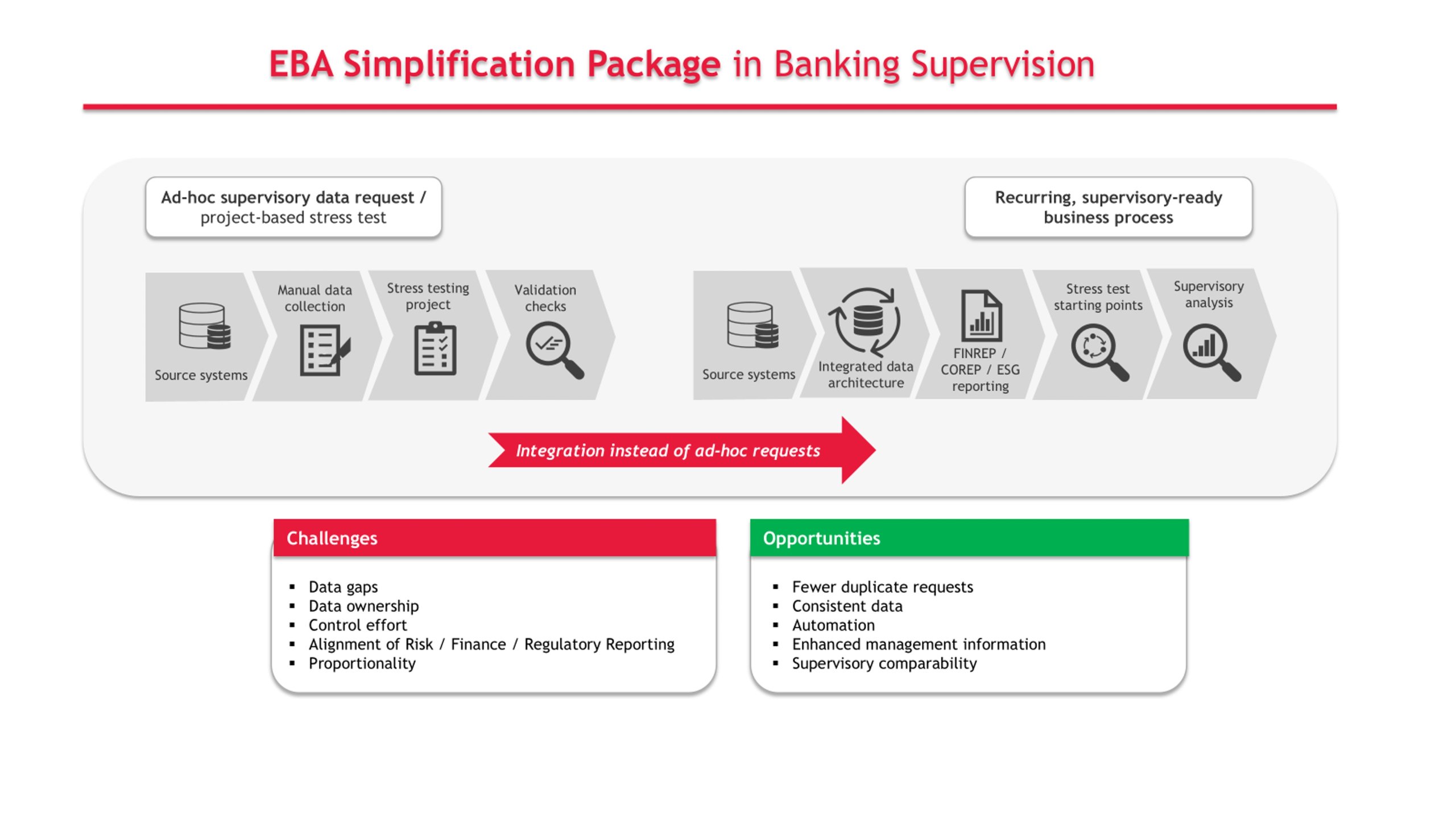
Despite the significant implementation effort, the package therefore offers benefits for both institutions and supervisory authorities. Banks can streamline processes, reduce duplication, and better integrate regulatory reporting with internal management frameworks. Supervisors benefit from greater comparability, enhanced analytical usability, and regularly available standardised starting points for supervisory analysis.
The greatest challenge lies in implementation under uncertainty. As details may still evolve during the consultation process, investing prematurely in highly specific technical solutions presents a risk. However, institutions should equally avoid waiting for the final regulatory package, as experience shows that data and process changes typically require substantial lead times.
A pragmatic impact assessment is therefore advisable. Such an assessment should extend beyond new data fields and encompass source systems, data quality, accountability structures, control frameworks, process documentation, and existing reconciliations between regulatory reporting, finance, and risk management functions. Institutions should additionally document data lineage for key data points, critically review manual process steps, and assess governance structures, including clearly defined data owners, technical responsibilities, and escalation pathways.
A key enabler may be the establishment of a “Golden Dataset” - a centrally validated and business-approved data repository serving as the single source of truth for regulatory reporting, risk analytics and stress testing. By providing a consistent reference point across functions, such a dataset can reduce interpretation risk, enhance data consistency and strengthen data quality and governance frameworks.
Most importantly, institutions should avoid treating these changes as a reporting-only initiative. Successful implementation requires close collaboration between risk management, finance, treasury, ESG, IT, regulatory reporting, compliance, and internal audit functions. Only through this cross-functional approach can data quality, business consistency, and control effectiveness be sustainably ensured.
Conclusion: Simplification Requires Preparation
The EBA Simplification Package pursues a worthwhile objective: less redundancy, greater proportionality, and better use of existing data. In the area of stress testing, however, it also demonstrates that regulatory simplification does not automatically translate into lower implementation effort. Instead, institutions must shift their focus from one-off data collections towards long-term data readiness.
Stress testing information will increasingly need to be embedded within regular processes, governance frameworks, and control environments. As a result, expectations regarding data quality, accountability, and explainability will continue to rise. The key message is clear:
The Simplification Package has the potential to reduce complexity in the long term — but only for institutions that proactively adapt their data, process, and governance foundations accordingly.