Updates
Date:
Hidden profit distributions (verdeckte Gewinnausschüttung; vGA) can affect not only the taxation of a corporation but also that of its shareholder. In practice triangular constellations also occur: if one company grants a societally induced economic benefit to its sister company, this can be treated as a vGA to the common shareholder and at the same time as the shareholder’s hidden contribution (verdeckte Einlage; vE) into the beneficiary company. If a tax assessment concerning a vGA is issued, revoked or amended for the granting company, Section 32a (1) of the German Corporation Tax Act (Körperschaftsteuergesetz; KStG) allows a corresponding correction for the shareholder or a person closely associated with him - also for assessments that have already become final. The German Federal Fiscal Court (Bundesfinanzhof; BFH) confirms with its judgment of September 8, 2026 (case no. IX R 16/25) that this also includes indirect consequential effects of a vGA, such as subsequent acquisition costs of the participation in the benefited sister company.
A shareholder was sole owner of A‑GmbH and held 50% of B‑GmbH. A‑GmbH granted loans to B‑GmbH totaling
EUR 485,000, which were only partially repaid.
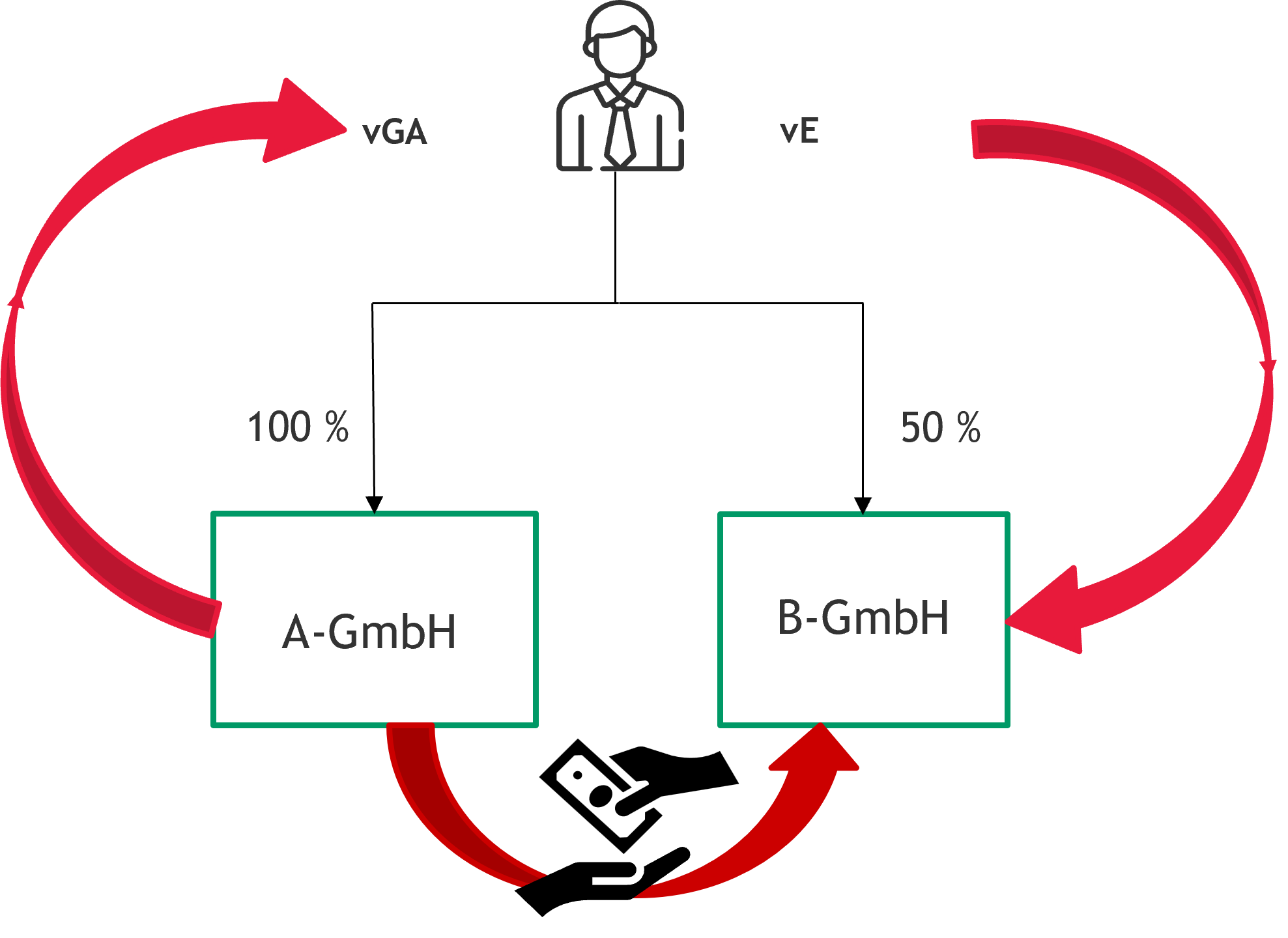
In December 2015 the liquidation of B‑GmbH became known. Thereupon A‑GmbH derecognized its remaining receivable, by agreement with the tax office, retrospectively as of December 31, 2012, with a profit‑reducing effect. At the same time the tax office recognized a vGA of EUR 479,995 at A‑GmbH (defaulted loan receivable and assumed costs for B‑GmbH). The tax office treated the vGA as dividend income of the shareholder for 2012.
The shareholder then applied for amendment of his final income tax assessment for 2015. He argued that the vE in B‑GmbH derived from the vGA results in subsequent acquisition costs of his participation. These should be taken into account when determining a disposal loss pursuant to Section 17 of the German Income Tax Act (Einkommensteuergesetz; EStG). The tax office considered the assessment no longer amendable; the fiscal court granted the action.
The BFH held that the conditions for the asserted disposal loss were not sufficiently clarified in the case and remitted the matter to the fiscal court.
However, it confirmed in principle the procedural possibility of amendment: Section 32a (1) KStG does not only refer to the direct recognition of the vGA as capital income for the shareholder, but also covers indirect consequential effects of a vGA such as acquisition costs, business expenses or income‑related expenses. The amendment is limited to the facts that led the company to recognize the vGA; however, this does not imply a quantitative limitation.
In the case of a benefit transfer between sister companies, as in the present dispute, a vE in the beneficiary company may be attributable to the common shareholder alongside a vGA. This can increase a later disposal loss as subsequent acquisition costs. Under Section 32a (1) KStG, both the recognition of the vGA and, in principle, the procedural attribution of the vE as acquisition costs are ensured.
Section 32a (1) KStG, however, links the taxation levels between company and shareholder only formally; the provision does not establish a broader substantive correspondence. Whether and to what extent a vGA exists must therefore be examined separately at each level. The existence and amount of a vE must also be assessed independently.
Therefore, the decisive question is whether B‑GmbH actually received an economic benefit in the form of a vE. The mere derecognition of the receivable at A‑GmbH is insufficient. What is required is an express or implied waiver of the claim that relieves B‑GmbH of its liability. Moreover, such a vE is measured by the part‑value of the receivable at the time of waiver. If the receivable was completely worthless, the waiver does not give rise to subsequent acquisition costs; vGA and vE therefore do not necessarily have to correspond in value.
In the second instance the fiscal court must therefore clarify in particular the waiver and the value/realizability and the allocation of any disposal loss to the year 2015. If its conditions are met, the assessment can be amended in the case pursuant to Section 32a (1) KStG.
Notice:
The BFH advocates a broad scope of application for Section 32a (1) KStG: indirect consequential effects of a vGA can also be taken into account in favor of the shareholder or a person closely associated with him in another assessment period. Apart from the constellation in the case in dispute, this may also affect situations in which the shareholder “uses up” the vGA for income‑relevant purposes (e.g. use of an interest‑free loan granted by the company for acquisition of a rental property). The judgment is therefore also relevant for participation structures with sister companies that frequently occur in practice - i.e. so‑called triangular constellations.
A vGA that has already been taxed, however, does not establish an equally high vE. For intra‑group loans, derecognition and waiver of receivables and their timings should therefore be clearly separated and the value/realizability of the receivable should be documented.