

E-invoicing mandate in Germany from 2027

Requirements, deadlines and successful implementation

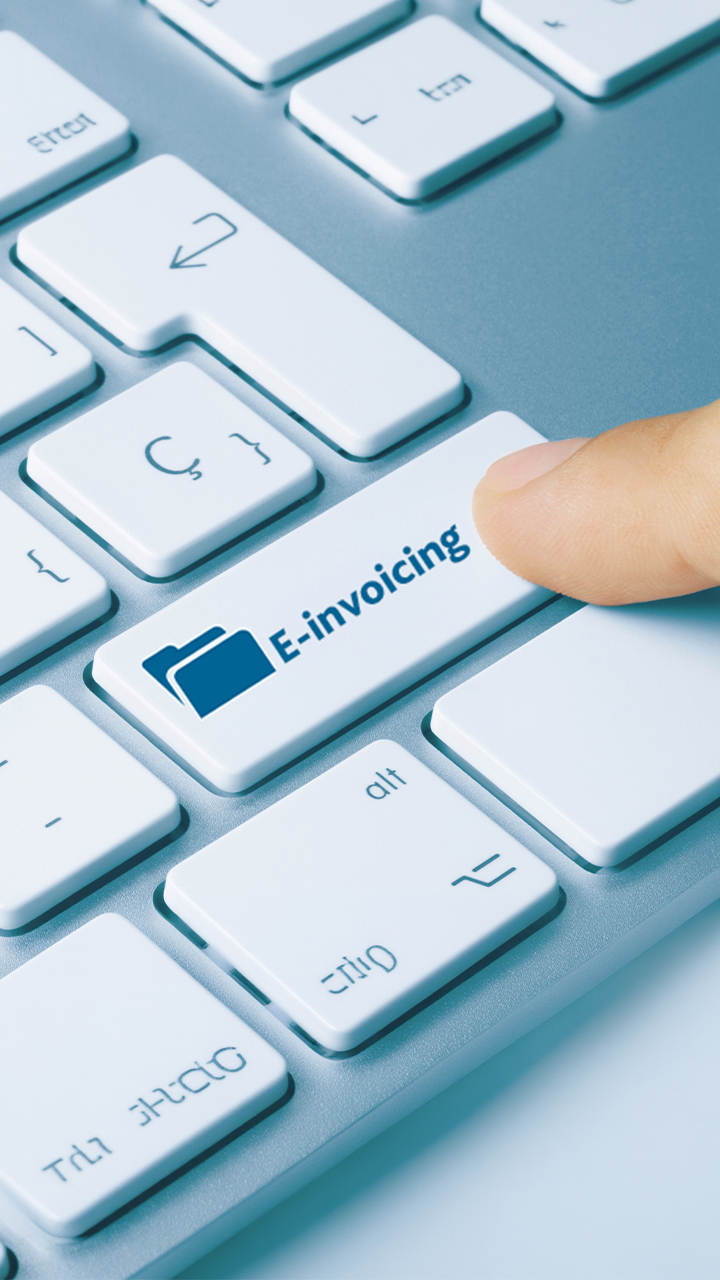
The person presses the button labeled E-Invoice"

Because companies should make the most of the time remaining before e-invoicing becomes mandatory

The e-invoicing mandate in Germany brings with it new regulatory, technical and organisational requirements. Many companies are currently asking themselves: Am I affected? What deadlines apply? Which systems and processes need to be adapted, and how can compliance be ensured? Companies should seize this opportunity now to adapt processes, systems and data structures in a targeted manner, reduce risks at an early stage and, at the same time, make good use of potential opportunities, such as the digitalisation of business processes, the modernisation of financial processes and the sustainable reduction of manual effort.

BDO supports you in implementing the requirements of the e-invoicing obligation efficiently, in compliance with the law and in a future-proof manner.

An e-invoice is a structured electronic invoice that can be processed automatically and complies with the requirements of the European standard EN 16931.

Unlike traditional PDF invoices, an e-invoice contains structured data records that can be processed, validated and archived automatically. This makes it possible to organise invoice verification, approval processes and accounting procedures much more efficiently and even automate them.

The most important e-invoice formats include:

  • XRechnung
  • ZUGFeRD
  • other EN 16931-compliant formats

In future, a plain PDF file will generally no longer be considered a legally compliant e-invoice.

The e-invoicing mandate applies in principle to all companies that provide taxable B2B services in Germany. The transition is particularly relevant for small and medium-sized enterprises, international groups, and organisations with complex ERP landscapes or high invoice volumes. Many companies face the challenge of adapting existing accounting processes and data structures to the new regulatory requirements. System landscapes that have evolved over time often make rapid and standardised implementation particularly difficult.

The introduction of e-invoicing will take place in stages.

  • From 1 January 2025
    Businesses must be able to receive e-invoices.
  • From 1 January 2027
    Businesses with a turnover in the previous year of more than EUR 800,000 must issue e-invoices.
  • From 1 January 2028
    The e-invoicing mandate will generally apply to almost all domestic B2B transactions.
  • From 1 July 2030
    The e-invoicing mandate will be extended to EU transactions, such as intra-Community supplies and acquisitions.

In addition, digital reporting obligations will be introduced as part of the European ViDA (VAT in the Digital Age) initiative, which is intended to replace the current recapitulative statement.

Companies can actively use the remaining time to adapt processes, systems and data structures in good time and minimise potential risks at an early stage. This presents opportunities to digitise and modernise business processes.

Person mit digitaler Checkliste

Checklist for e-invoicing mandate: Is your business ready?

The introduction of e-invoicing mandate affects far more than just the accounts department. It often also impacts procurement, sales, master data management, tax functions, document management and IT.

This checklist provides an initial overview of the key areas for action.

1. Assess the scope of impact

Identify which companies, business units and transactions are affected by the e-invoicing mandate.

2. Evaluate deadlines

Check which legal deadlines apply to your organisation and when specific action is required.

3. Document invoicing processes

Record existing incoming and outgoing invoice processes and identify manual steps and media breaks.

4. Analyse the ERP and system landscape

Assess which systems are currently used for the creation, processing and archiving of invoices.

5. Ensure data quality

Check whether customer, supplier and tax data is maintained in a complete, up-to-date and consistent manner.

6. Define suitable invoice formats

Determine which formats should be supported in future, for example XRechnung or ZUGFeRD.

7. Review archiving

Ensure that electronic invoices can be archived in an audit-proof and GoBD-compliant manner.

8. Identify opportunities for automation

Use the introduction of e-invoicing to digitise existing processes and reduce manual tasks.

9. Identify and involve the relevant business units

Assess at an early stage which departments will be affected by the introduction of e-invoicing. In addition to accounting and tax functions, the transition often also affects procurement, sales, master data management, IT, document management and compliance functions.

10. Select a future-proof solution

Take future requirements such as ViDA, digital reporting obligations and other European developments into account today.

Please answer the following questions with “Yes” or “No”:

  • Are you already able to receive structured e-invoices?
  • Can you generate EN 16931-compliant e-invoices?
  • Are your ERP systems prepared for e-invoicing?
  • Is your archiving designed to be audit-proof?
  • Is your master data adequately maintained?
  • Are your invoicing processes documented?
  • Have you already assessed the impact of ViDA?
  • Is there an implementation project in place with defined responsibilities and a timeline?

If you answer “No” to several questions, an early analysis of your processes and systems is recommended.

Which areas of a business are affected by the e-invoicing mandate?

The e-invoicing mandate is often perceived as purely an accounting or tax project. In practice, however, the introduction of electronic invoicing processes affects numerous areas of a business.

Depending on the organisational structure, the following functions, amongst others, may be involved.

  • Financial accounting and bookkeeping
  • Tax function and tax compliance
  • Purchasing and procure-to-pay processes
  • Sales and order-to-cash processes
  • Master data management
  • IT and ERP management
  • Document management and archiving
  • Compliance and Internal Control System (ICS)

Why a holistic approach is crucial

Companies that view the e-invoicing mandate solely as an accounting project often underestimate the actual effort involved in implementation.

A successful implementation usually requires collaboration between various departments. The earlier the relevant functions are involved, the more efficiently regulatory requirements can be met and opportunities for process automation exploited.

The introduction of electronic invoicing processes often affects a company’s entire process and system landscape. In addition to regulatory requirements, existing workflows must be adapted from a technical, organisational and operational perspective.

Typical challenges include:

  • legacy ERP structures
  • custom interfaces
  • inconsistent data structures and a combination of multiple legacy systems
  • manual invoicing processes
  • international compliance requirements
  • lack of system compatibility

At the same time, there is growing pressure to make invoicing processes more efficient and simpler, and to reduce manual effort in the long term.

The technical implementation of e-invoicing requires far more than just a simple format conversion. Companies need solutions for the creation, validation, transmission and audit-proof archiving of electronic invoices.

Integration with existing ERP and accounting systems is particularly important, such as:

  • SAP
  • Microsoft Dynamics
  • Oracle
  • DATEV
  • custom ERP environments

A modern e-invoicing solution should integrate flexibly into existing processes whilst also taking future regulatory requirements into account.

Under the European initiative ‘VAT in the Digital Age’ (ViDA), the EU is planning additional digital reporting obligations and real-time reporting requirements, which will come into effect from 1 July 2030. Companies with international business relationships should therefore assess at an early stage how existing processes and systems can be prepared for future European requirements. Those who invest in scalable and standardised e-invoicing processes today are laying the foundations for long-term compliance and greater process reliability.

E-invoicing: why businesses should act now

Many businesses underestimate the effort involved in switching to e-invoicing. The transition affects not only the accounts department, but also, amongst other areas, procurement, sales, master data management, archiving and tax processes. 

Furthermore, delayed implementation creates risks: incorrect invoice formats, delays in invoice exchange, problems and risks relating to input tax deduction, increased manual effort and compliance risks. 

The closer the legal deadlines get, the more severe the resource bottlenecks in IT and implementation projects will become.

E-invoicing: an opportunity for process optimisation

The introduction of e-invoicing is not merely a compliance project, but an important step towards the digitalisation of businesses and processes. Companies can use this transition to automate financial processes in the long term and make them more efficient.

Modern e-invoicing processes enable companies to: reduce error rates, shorten invoice processing times, improve data quality, increase transparency, reduce manual tasks and speed up payment processes.

This makes e-invoicing a key component of the digital finance function.

Implementing the e-invoicing mandate efficiently and with future-proofing with BDO

Companies do not have to tackle the introduction of the e-invoicing mandate on their own. BDO already offers scalable and tried-and-tested e-invoicing solutions that enable companies to implement regulatory requirements efficiently and with future-proofing. BDO’s solution acts as a central interface between ERP systems, future platforms and archiving and reporting systems. This enables electronic invoicing processes to be automated, compliance requirements to be reliably met and existing system landscapes to be efficiently expanded. By using the BDO interface solution as a standalone component, future adjustments to the IT architecture are not further complicated by a clear separation of functions. Rather, it represents a flexible and valuable building block within a comprehensive functional solution. 

Depending on company size, invoice volume and integration requirements, BDO offers a range of service models – from streamlined solutions to complex enterprise integrations with international requirements. 

The focus is on regulatory compliance, ERP integration, process automation, GoBD-compliant archiving, international scalability, future-proofing with regard to ViDA and other European requirements.

Are your processes already prepared for the e-invoicing mandate?

BDO can help you carry out a targeted assessment of your current situation and offers tailor-made solu-tions: from a structured analysis of your processes, systems and risks right through to implementation. This will enable you to lay the foundations for complying with the e-invoicing mandate efficiently, in full compliance with the law and in a way that is future-proof.

FAQ on the e-invoicing mandate

Kontaktieren Sie uns!

Daniel Auer

Daniel Auer

Senior Manager, German Indirect Tax
View bio
Eva Sareiter

Eva Sareiter

Certified Tax Advisor, Lawyer, Partner, Tax & Legal
View bio
Patrick Bernd Findeis

Patrick Bernd Findeis

Certified Tax Consultant, Partner, Tax & Legal
View bio