Updates
Date:
Body cross-border intra-group service and payment relationships are regularly the focus of tax audits. For controlling shareholders, a hidden profit distribution can be assumed not only because of a remuneration that is not in line with dealings at arm’s length, but also due to the absence of clear, pre‑agreed and actually implemented agreements (so‑called formal arm’s‑length comparison). The German Federal Fiscal Court (Bundesfinanzhof; BFH) confirms, in essentially identical decisions of June 24, 2026 (case no. I R 57/23 and case no. I R 56/23 (NV)), that Article 9 (1) of the Double Taxation Agreement with Cyprus 2011 (DTA Cyprus 2011) can, in principle, prevent a profit adjustment that is based solely on such formal deficiencies. At the same time, it limits this treaty protection: purely asset-managing entities are, due to the lack of treaty‑law entrepreneurial status, regularly not covered by the blocking effect.
The sole shareholder of the German GmbH was X‑Ltd., resident in Cyprus, whose shares were in turn 100 % held by Cypriot Y‑Ltd. In 2013 the GmbH acquired a domestic property for approximately EUR 8.74 million. Y‑Ltd. actually provided services in this context, including reviewing the purchase agreement, assisting with price negotiations and conducting technical due diligence, and invoiced approximately EUR 87,000. According to the findings of the Fiscal Court, the remuneration was arm’s‑length in amount. However, an explicit written prior agreement was not proven. The tax office therefore assumed a hidden profit distribution. The Fiscal Court affirmed a breach of the formal arm’s‑length comparison but considered the adjustment blocked by Article 9 (1) DTA Cyprus 2011.
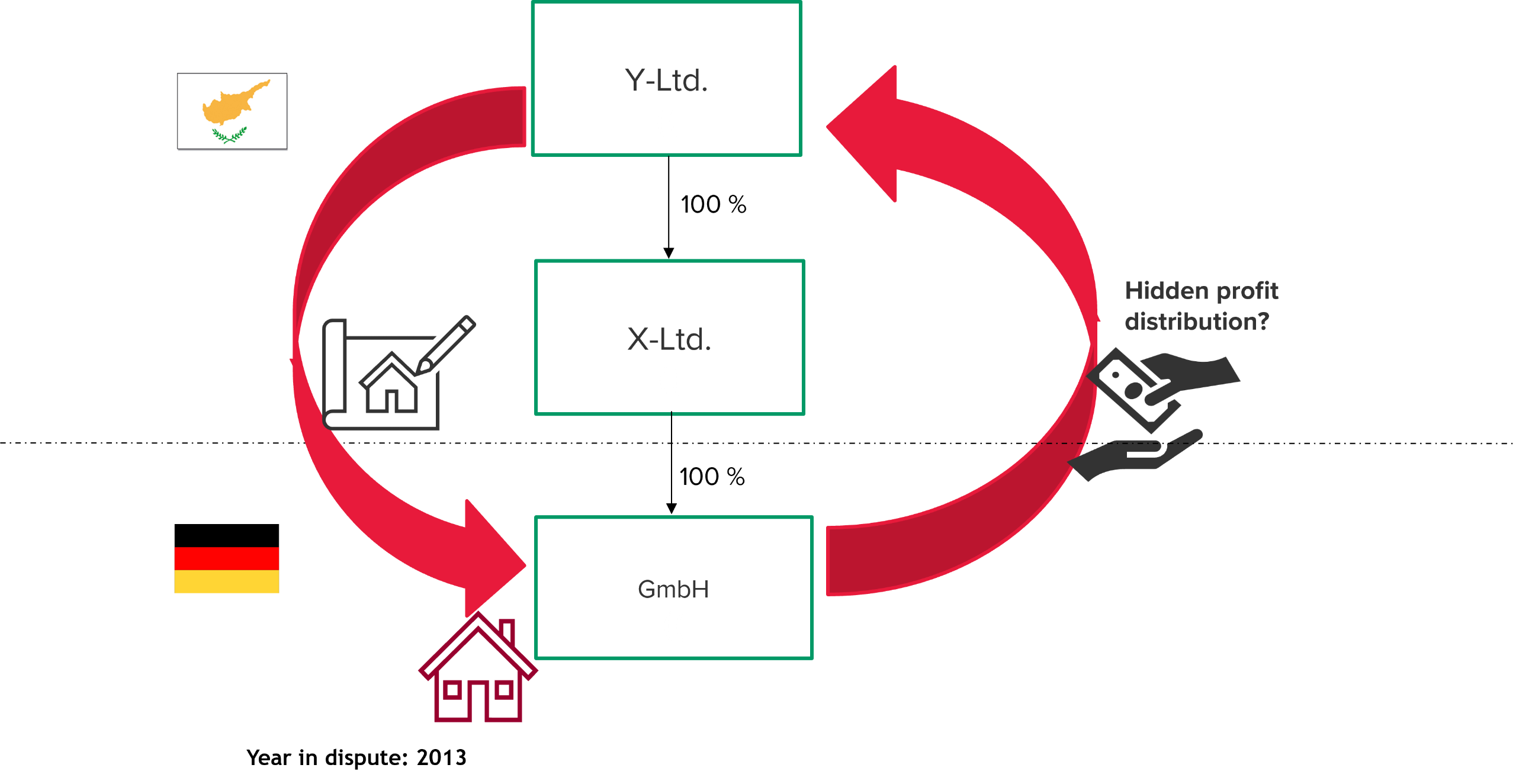_BFH_Urteil_vom_24-06-2026.png)
The BFH found that neither the assumption of a hidden profit distribution nor the applicability of the treaty‑law blocking effect was finally resolved and remitted the case to the Fiscal Court. The mere absence of an explicit individual contract does not automatically constitute a breach of the formal arm’s‑length comparison. A comprehensive assessment of the formal criteria and the extent of their violation is required. Group‑wide pre‑existing, substantively identical and consistently applied standard arrangements can form a sufficiently clear contractual basis. The Fiscal Court must therefore determine on retrial, in particular, whether and at what time such arrangements, possibly also concluded implicitly, existed.
Article 9 (1) DTA Cyprus 2011 does not itself create an independent tax adjustment, but it does set a treaty‑law limit to national profit adjustments. The formal arm’s‑length comparison concerns not the commercial or financial “terms” agreed between related companies, but the nature and timing of their agreement and implementation. A hidden profit distribution adjustment that is derived solely from the special formal requirements regarding the arm’s‑length comparison for controlling shareholders can therefore still be blocked by Article 9 (1) DTA Cyprus 2011. Formal aspects, however, remain admissible as indicia when examining the actual arm’s‑length nature.
Crucial, however, is that the blocking effect only applies to entities that qualify as enterprises under the treaty. The concept of an enterprise in the DTA Cyprus requires an economic activity (Article 3 (1) letters f and g). Even though a more extensive definition is lacking, according to the BFH a purely asset‑managing activity is not sufficient; the national commerciality fictions of Section 15 (3) no. 2 of the German Income Tax Act (Einkommensteuergesetz; EStG) and of Section 8 (2) of the German Corporation Tax Act (Körperschaftsteuergesetz; KStG) are not transferable. If the German GmbH was merely a single‑asset entity limited to asset management, Article 9 (1) DTA Cyprus 2011 would therefore not be applicable. The vGA would then have to be examined under domestic rules, inter alia Section 8 (3) sentence 2 KStG, without a treaty‑law blocking effect. The Fiscal Court must make further findings on this point on retrial.
Notice:
The BFH decisions of June 24, 2026 are particularly relevant for asset‑managing holding, real estate and single‑asset structures, where national presumptions of commercial activity must not be equated with the treaty‑law concept of an enterprise. For cross‑border group services, the content of the service, remuneration and the period of applicability should be clearly documented prior to performance and evidenced by consistently applied standard arrangements; the absence of a written individual contract alone does not necessarily by itself entail the risk of a hidden profit distribution.
The statements of the BFH regarding the blocking effect with respect to Article 9 (1) DTA Cyprus 2011 are - given that this rule is comparable to Article 9 (1) of the OECD Model Tax Convention - also relevant for other countries.