Updates
Date:
According to Section 4i sentence 1 of the German Income Tax Act (Einkommensteuergesetz; EStG), expenses may not be deducted as special business expenses to the extent that they also reduce the tax base in another state. This provision is intended, in particular, to resolve taxation conflicts arising from the German peculiarities of co-entrepreneur taxation. It is intended to prevent expenses of the foreign partner that are to be taken into account as deductible special business expenses at the domestic co-entrepreneurship from also having a reducing effect abroad (so-called double dip in the inbound case). A classic application is the financing of the acquisition of shares in the co-entrepreneurship or the activity of the co-entrepreneurship through foreign group companies of the foreign partner.
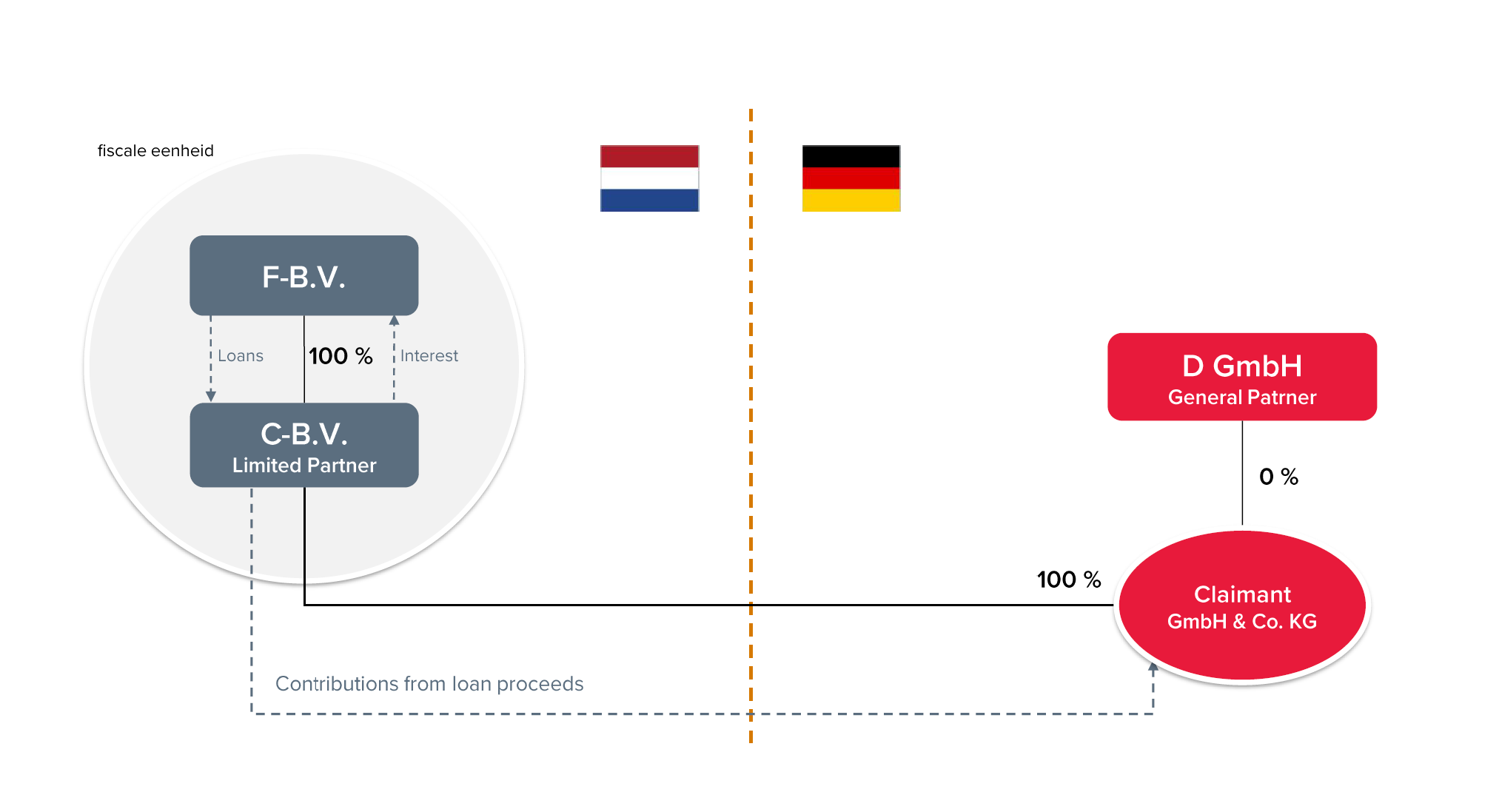
The dispute before the German Federal Fiscal Court (Bundesfinanzhof; BFH) can be simplified as follows: The plaintiff was a GmbH & Co. KG resident in Germany, in whose company assets in the tax year 2017 the C-B.V., resident in the Netherlands and joined to the proceedings, held a 100% limited partnership interest. The non-capital-contributing general partner of the plaintiff was D GmbH, resident in Germany. C-B.V. was itself 100% owned by F-B.V., resident in the Netherlands. C-B.V. and F-B.V. formed a so-called "fiscale eenheid" under Dutch law and were therefore taxed as a group in the Netherlands. As early as 2015, F-B.V. granted several loans to C-B.V. so that C-B.V. could make the corresponding contributions to the plaintiff. Interest on the loans was paid monthly by C-B.V. to F-B.V. The plaintiff recorded the liabilities from the loans granted by F-B.V. in a special balance sheet of C-B.V. and treated the interest expense as C-B.V.’s special business expenses. The tax audit for the years 2015 to 2017 took the view that the loan interest paid by the joined party to finance its contribution qualified as special business expenses and were subject to the deduction prohibition of Section 4i sentence 1 EStG applicable from 2017.
With its decision of June 11, 2026 (case no. IV R 36/23), the BFH now fundamentally clarifies the application of Section 4i EStG:
This is particularly true against the background that the "fiscale eenheid" (tax unit) within group taxation systems is by type a result-consolidation system and leads to the legal relationships between group members being disregarded for tax purposes. According to the legislative objective of Section 4i EStG, the terms foreign "tax base" and "reduce" should be specified on the basis of an economic assessment.
According to the purpose of Section 4i EStG, it is therefore irrelevant whether the special business expenses are technically shown as a deduction item in the tax profit determination. A reduction also occurs if expenses and the corresponding income are disregarded as intra-group transactions within foreign group taxation. For even in that case the expenses affect the tax result of a taxable person. It is likewise irrelevant that this effect abroad does not occur at the joined party but at another taxable person - the "tax unit".
Notice
In practice, it must therefore always be examined whether the expenses classified domestically as special business expenses reduce the tax base abroad when viewed from an economic perspective.